

Best Kids E-Bikes Under $700 (2026): What Parents Should Actually Buy
Meta Description: Looking for a kids e-bike under $700? We compare 7 models on safety, weight, range, and UL certification. The Prince series stands out with dual TÜV certs and 32-mile range.
By Ted
TL;DR
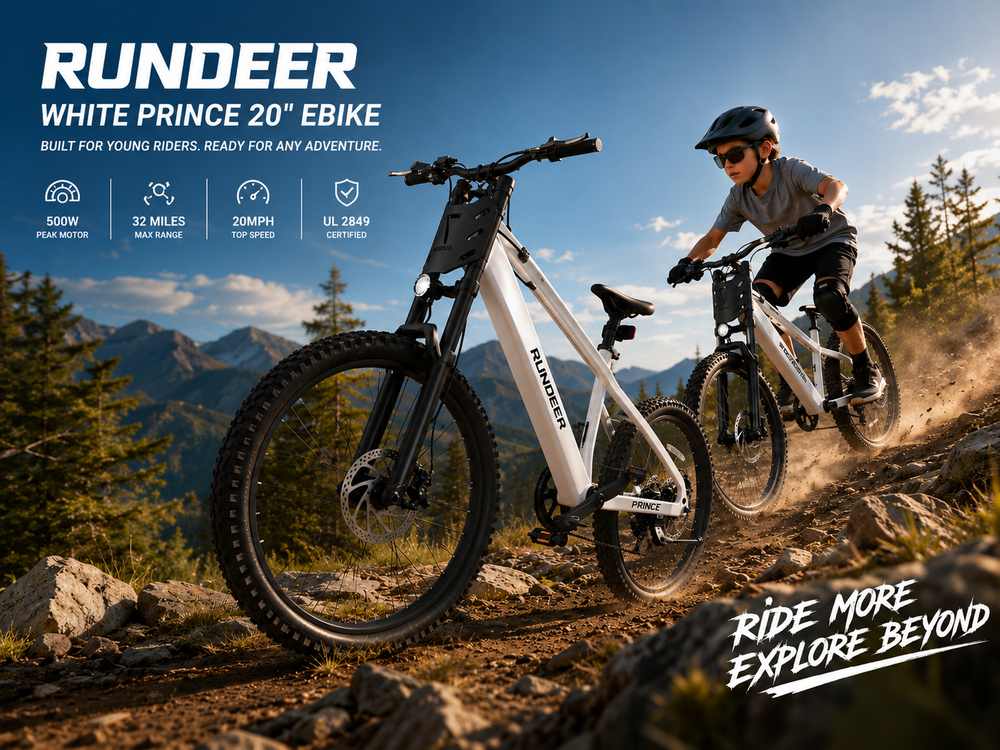
After comparing seven kids and youth e-bikes priced below $700. For families prioritizing low weight, long range, and third-party safety certification, the Prince series is one of the strongest options currently available under $700.. At $599.99 MSRP (standard) and $699.99 MSRP (Black Gold edition), it delivers the lightest frame in class at 35 lbs, the longest range at 32 miles, and is the only option under $700 to carry both TÜV-certified UL 2849 and UL 2271 certifications. Most competitors either skip safety certifications entirely, rely on lead-acid batteries, or weigh nearly three times as much—trade-offs that matter when your child is the one riding.
1. Why $700 Is the Sweet Spot for Kids' E-Bikes
Walk into any big-box retailer or browse Amazon's e-bike category and you'll see kids' electric bikes spanning from $199 balance bikes to $4,000 junior mountain machines. The $500–$700 corridor is where the market gets interesting—and where parents need to be the most careful.
Below $500, you're almost certainly looking at compromise. Budget models in the $200–$400 range—like the Hiboy BK1 ($189–$199) or the Razor MX350 ($240–$314)—serve narrow use cases well but fall short as everyday ride-to-school or neighborhood-cruising machines. The BK1, for instance, uses a 21.6V/2Ah battery that delivers only 4.9 miles of range and a top speed of 9 mph, appropriate for a 3–5 year-old learning balance but underpowered for a growing 10-year-old (ElectricRide360). The MX350 runs on sealed lead-acid batteries that provide just 30–40 minutes of runtime and take 12 hours to recharge—a non-starter for kids who want to ride daily (ElectricRide360).
Above $800, you enter premium territory—models like the Lectric XP Lite 2.0 ($799) and the Woom UP 5 ($2,659+) offer excellent components but exceed the budget most families set for a bike a child will outgrow in 2–3 years (Electric Bike Report).
The $500–$700 window is the sweet spot because it's where you can realistically find:
- Lithium-ion batteries with 15+ miles of real-world range (no lead-acid)
- Aluminum frames light enough for a 7-year-old to maneuver
- Safety certifications (UL 2849, UL 2271) that verify electrical integrity
- Age-appropriate speed controls that let parents limit top speed
- Proper drivetrains (multi-speed gearing, not single-speed throttle-only)
Not every bike in this range delivers all five. In fact, most deliver three or fewer. The gap between what's available and what's safe is wider than most parents realize—and that's exactly why certification matters.
2. Safety Certifications: Why UL 2849 TÜV and UL 2271 TÜV Are Non-Negotiable
The E-Bike Fire Problem Is Real
Between 2021 and 2024, the U.S. Consumer Product Safety Commission documented over 400 incidents of micromobility device fires, with lithium-ion battery failures as the leading cause. In New York City alone, e-bike and scooter battery fires injured 190 people and killed 6 in 2023 (CPSC). The root cause in most cases: uncertified battery packs with inadequate battery management systems (BMS), often sourced from manufacturers who skipped independent testing to keep costs down.
What UL 2849 and UL 2271 Actually Test
UL 2849 is the comprehensive e-bike system standard. It evaluates the entire electrical system—battery, charger, motor controller, wiring harness, and display—as a single integrated unit. Tests include overcharge protection, short-circuit resistance, thermal management under sustained load, and motor lock-up scenarios. A bike that passes UL 2849 has demonstrated that its electrical components won't cascade into a thermal event under fault conditions.
UL 2271 is the battery-specific standard. Originally developed for hoverboards and e-scooters, it focuses on the battery pack itself: cell balancing, over-discharge protection, vibration resistance, crush testing, and water ingress. UL 2271 certification means the battery pack can withstand the physical abuse that a kids' bike inevitably receives—drops, rain, being knocked over in the garage.
Why TÜV Certification Matters
Here's what many buyers miss: UL standards can be self-tested. A manufacturer can build a lab, run the tests, and claim "UL compliant" without an independent third party ever verifying the results. When a product carries TÜV-certified UL 2849 and TÜV-certified UL 2271, it means TÜV Rheinland or TÜV SÜD—independent, internationally recognized testing organizations—performed or witnessed the testing and issued the certification. The difference is the difference between a manufacturer grading its own homework and an independent auditor verifying every answer.
In the sub-$700 kids' e-bike market, dual TÜV-certified UL 2849 + UL 2271 is exceptionally rare. Most competitors carry no certification at all. The GOTRAX Nano and Fitz16 list UL 2849 compliance (GOTRAX), but without TÜV verification. The Razor MX650 carries UL 2272 (a scooter standard, not the e-bike-specific UL 2849) (ElectricRide360). The Swagtron EB-6 and Hiboy DK1 list no UL certifications at all in their specifications (ManualsLib) (ElectricRide360).
For a product your child rides daily and charges in your home, independent third-party verification isn't a luxury—it's a baseline requirement.
3. Key Buying Criteria for Kids' E-Bikes Under $700
Weight: Lighter Is Safer
A bike that weighs more than your child is fundamentally unsafe. When a 70-pound 10-year-old tries to control a 95-pound Razor MX650 at speed, the physics work against them—stopping distances increase, low-speed wobbles are harder to correct, and picking up a dropped bike becomes a struggle (SmartBuy). Industry guidance suggests kids' e-bikes should weigh no more than 40 lbs for riders aged 7–12, and preferably under 35 lbs for the youngest in that range (TST EBike).
At 35 lbs (16 kg), the Prince series sits at the low end of the weight spectrum for motorized bikes—comparable to high-end pedal-only kids' mountain bikes and 13+ pounds lighter than the Swagtron EB-6 (48.5 lbs) and 60 pounds lighter than the Razor MX650 (95 lbs). For a 7-year-old, that weight difference is the difference between confidently managing the bike at a stop sign and struggling to keep it upright.
Speed and Power Delivery
The federal Class 1 e-bike definition caps pedal-assist speed at 20 mph and requires the rider to be pedaling for the motor to engage. This is the safest classification for young riders because:
- The motor only amplifies the rider's own effort—there's no surprise acceleration from a dead stop
- Speed is naturally limited by cadence, making 20 mph the ceiling rather than a target
- Class 1 e-bikes are legal on the most bike infrastructure in the most states—bike lanes, multi-use paths, and park trails where Class 2 (throttle) and Class 3 (28 mph) bikes are often restricted (GoEBikeLife)
The Prince series operates as a pure Class 1 pedal-assist bike with no throttle. Its three assist modes—Green (≤10 mph), Yellow (≤16 mph), and Red (≤20 mph)—function as progressive speed governors. A parent can start a new rider in Green mode and unlock higher speeds as skills and judgment develop. This is functionally identical to the parental controls on premium kids' models like the Segway Ninebot e-bike ($549–$649), but at a lower price point (ElectricRide360).
Competitors with throttle-only operation—like the Razor MX650 and Hiboy DK1—deliver power on demand regardless of pedaling input. While thrilling, throttle-driven acceleration is harder for inexperienced riders to modulate and eliminates the physical engagement that makes e-bikes a healthy activity rather than a powered scooter (GoEBikeLife).
Braking Systems
Two types of brakes dominate the kids' e-bike market: cable-actuated (mechanical) disc brakes and hydraulic disc brakes. Cable brakes use a steel cable to squeeze the caliper—simple, affordable, and easy to adjust at home with basic tools. Hydraulic brakes use pressurized mineral oil to actuate the caliper—stronger, more consistent, and better in wet conditions, but more expensive and harder to service.
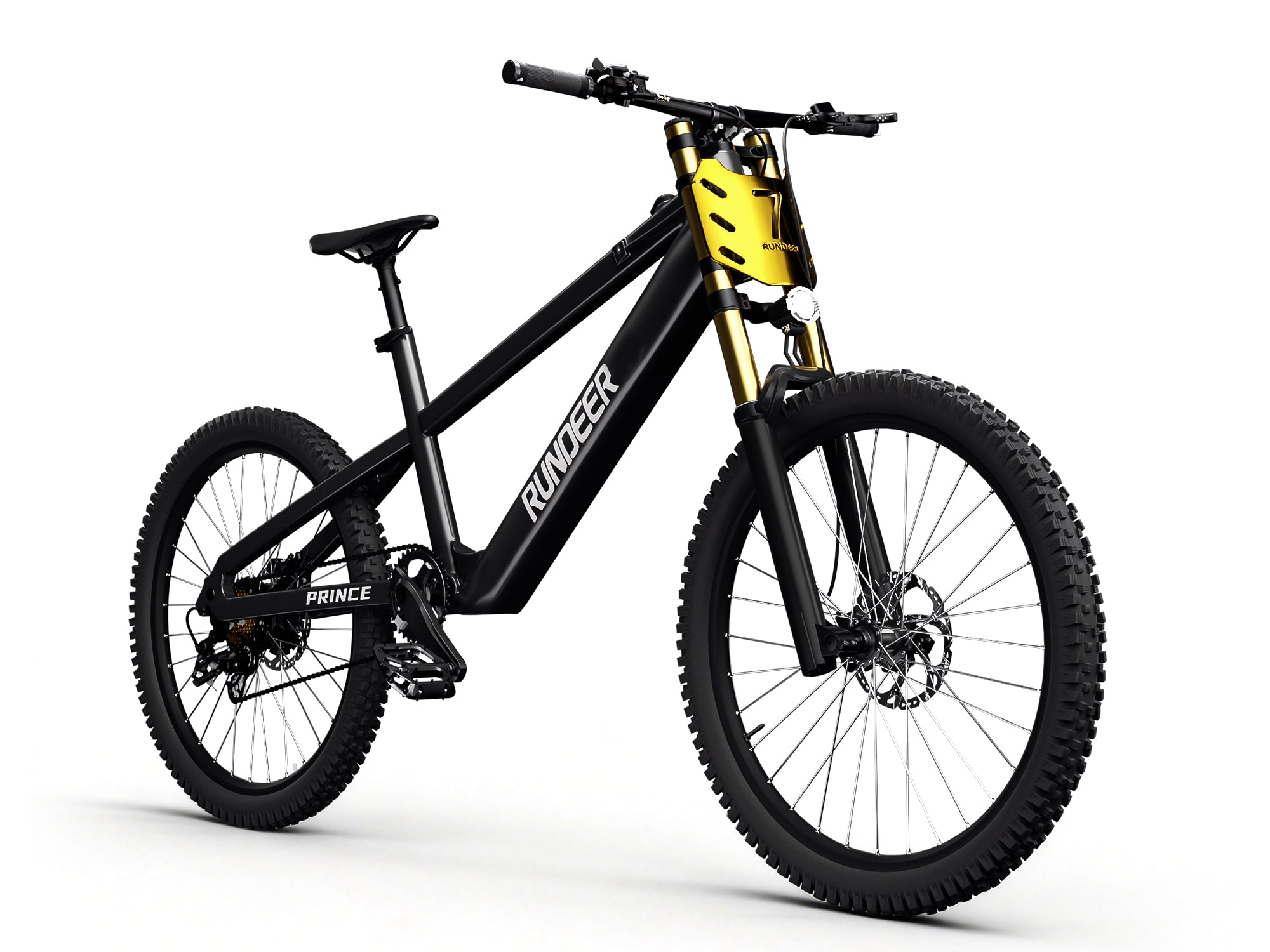
For most young riders on neighborhood streets and park paths, cable disc brakes provide more than enough stopping power when properly maintained. The Prince standard edition uses cable disc brakes, while the Black Gold edition upgrades to hydraulic oil brakes (Sulun brand)—a meaningful improvement for heavier riders, wet-weather commuting, or hilly terrain.
By comparison, the Razor MX650 relies on a single rear drum brake, which provides significantly less stopping power than any disc brake system. The Swagtron EB-6 uses mechanical disc brakes, and the GOTRAX Fitz16 uses dual disc brakes of unspecified type (GOTRAX) (ManualsLib).
Range and Battery
Range claims on e-bikes are notoriously optimistic—manufacturer figures typically assume a lightweight rider on flat terrain at low assist. A realistic rule of thumb is to expect 60–80% of the quoted range under real-world conditions with a child rider (VICTRIP).
The Prince series quotes 32 miles (50 km) of maximum range on a single charge, which translates to roughly 20–25 real-world miles—enough for a full week of school commutes (2–3 miles each way) plus weekend rides without midweek charging. Its 5-hour charge time means a dead battery is fully replenished between dinner and bedtime.
This is a stark contrast to the Razor MX650's 40-minute lead-acid runtime (requiring 12 hours to recharge) and the GOTRAX Fitz16's 16-mile quoted range (likely 10–12 miles in practice). The Hiboy DK1's 13.7-mile range and the Swagtron EB-6's ~20-mile range both fall short of the Prince's 32-mile figure (ElectricRide360) (ManualsLib).
4. Competitor Comparison: 7 E-Bikes Under $700
| Feature | Prince Standard | Prince Black Gold | GOTRAX Fitz16 | Razor MX650 | Hiboy DK1 | Swagtron EB-6 | JOYSTAR 20" |
|---|---|---|---|---|---|---|---|
| MSRP | $599.99 | $699.99 | $484–$699 | $499–$599 | $499–$609 | $499–$599 | $439 |
| Ages | 7–14 | 7–14 | 8+ | 13+ | 5–10 | 10+ | 7+ |
| Rider Height | 4'3"–5'7" | 4'3"–5'7" | N/A | N/A | N/A | N/A | N/A |
| Rated Motor | 250W | 250W | 350W | 650W | 300W | 350W | 250W |
| Max Torque | 40 N·m | 40 N·m | N/A | N/A | N/A | N/A | N/A |
| Top Speed | 20 mph | 20 mph | 15.5 mph | 17 mph | 15.5 mph | 18.6 mph | 15 mph |
| E-Bike Class | Class 1 | Class 1 | N/A | Throttle-only | Throttle-only | Throttle + Pedal | Pedal-assist |
| Max Range | 32 mi | 32 mi | 16 mi | ~6 mi* | 13.7 mi | ~20 mi | 15 mi |
| Battery | Li-ion | Li-ion | Li-ion | Lead-acid | 36V Li-ion | 36V 7.8Ah Li-ion | 24V 5.2Ah Li-ion |
| Bike Weight | 35 lbs | 35 lbs | ~45 lbs | 95 lbs | ~50 lbs | 48.5 lbs | ~45 lbs |
| Frame | Aluminum | Aluminum | Aluminum | Steel | Steel | N/A | Steel |
| Wheels | 20×2.0" | 20×2.0" | 16" | 16"/14" | N/A | 20" fat tire | 20×2.25" |
| Front Suspension | Oil, dual-crown | Oil, dual-crown + Kashima | None | Dual suspension | None | None | None listed |
| Brakes | Cable disc | Hydraulic disc (Sulun) | Dual disc | Rear drum only | Disc | Disc | Mech. disc |
| Drivetrain | Shimano 7-speed | Shimano 7-speed | Single | Single (chain) | N/A | 7-speed | Single |
| Speed Modes | 3 (Green/Yellow/Red) | 3 (Green/Yellow/Red) | N/A | 2 (Low/High) | 3 (5/7.5/15.5 mph) | N/A | 3 PAS modes |
| Charge Time | 5 hrs | 5 hrs | N/A | 12 hrs | 4–5 hrs | 4–5 hrs | N/A |
| Max Payload | 240 lbs | 240 lbs | 220 lbs | 220 lbs | 140 lbs | 264 lbs | N/A |
| Certifications | TÜV-cert. UL 2849 + UL 2271 | TÜV-cert. UL 2849 + UL 2271 | UL 2849 (no TÜV) | UL 2272 | None listed | None listed | None listed |
| Warranty | 1 yr (core) | 1 yr (core) | 2 yr | N/A | N/A | 1 yr limited | 12 mo |
*Razor MX650 range is listed as "40 minutes runtime" rather than distance; ~6 miles estimated at 17 mph sustained.
Key takeaway from the table: Only the Prince series combines sub-40-lb weight, 20+ mph Class 1 pedal assist, 30+ mile range, multi-speed Shimano drivetrain, front oil suspension, and independently verified dual TÜV safety certification—all within the $700 budget ceiling.
5. Prince Standard vs. Black Gold: How to Choose
The two Prince editions share the same frame, motor, battery, electronics, and geometry. The $100 difference comes down to two component upgrades on the Black Gold edition:
Front Suspension: Kashima-Coated Oil Fork
The standard Prince features a black dual-shoulder oil suspension fork that provides smooth, progressive damping on neighborhood streets and park paths. The Black Gold edition upgrades to a gold dual-shoulder oil fork with Kashima coating—a hard-anodized surface treatment originally developed for professional mountain bike and motocross suspension.
Kashima coating reduces stiction (static friction) between the fork tube and the damper seal, meaning the fork reacts faster to small bumps and provides a more supple, controlled ride over rough terrain. If your child rides on gravel trails, root-covered paths, or rough sidewalks, the Kashima fork delivers a noticeably more comfortable and controlled ride. On smooth pavement, the difference is subtle.
Brakes: Hydraulic Oil Disc (Sulun Brand) vs. Cable Disc
The standard edition's cable-actuated disc brakes are effective and easy to maintain—most home mechanics can adjust cable tension and replace pads with basic tools. The Black Gold edition's Sulun hydraulic disc brakes provide stronger, more consistent stopping power with less lever effort—important for:
- Smaller hands that may struggle to squeeze a cable brake lever firmly
- Wet-weather riding where hydraulic brakes maintain consistent bite
- Heavier riders approaching the 240-lb payload limit
- Hilly terrain where sustained braking generates heat that can cause cable-actuated fade
Recommendation
Choose the standard edition ($599.99 MSRP) if your child primarily rides on flat, paved surfaces and you're comfortable performing basic brake adjustments. It's an outstanding value that doesn't compromise on safety certifications, range, or weight.
Choose the Black Gold edition ($699.99 MSRP) if your child rides varied terrain (gravel, trails, hills), lives in a rainy climate, or is on the larger/older end of the 7–14 age range. The hydraulic brakes and Kashima-coated fork are both safety upgrades, not cosmetic ones—the $100 premium is justified by meaningful performance improvement where it matters most.
6. Parent FAQ
Q: Is a throttle better than pedal assist for kids?
A: No, and for most families the opposite is true. Pedal-assist e-bikes (Class 1) require the rider to pedal for the motor to engage, which means the child is always physically active and in control of the power delivery. Throttle-only bikes like the Razor MX650 and Hiboy DK1 deliver instant power on demand, which can surprise inexperienced riders and reduce the physical activity benefit. Pediatric occupational therapists consistently recommend pedal-assist models for developing riders because the motor amplifies effort rather than replacing it (GoEBikeLife). The Prince series is pedal-assist only—no throttle—and we consider that a safety feature, not a limitation.
Q: What age can my child start riding an e-bike?
A: It depends on the child's height, coordination, and maturity, not just their age. The Prince series fits riders 4'3" to 5'7" (130–170 cm), which corresponds to approximately ages 7–14 based on CDC growth charts. A tall 6-year-old may fit; a small 8-year-old may not. The critical test: can your child comfortably straddle the bike with both feet flat on the ground while gripping the handlebars? If not, the bike is too big (Electric Bike Report). Always start in the lowest assist mode (Green, ≤10 mph) and progress gradually.
Q: Does my child need a license to ride an e-bike?
A: In most U.S. states, no license is required for Class 1 e-bikes regardless of rider age. However, some states impose minimum age requirements (typically 14 or 16) for Class 3 e-bikes that can reach 28 mph. The Prince series is a Class 1 e-bike capped at 20 mph, which is the most broadly accessible classification. Check your state's DMV website for specific age and helmet requirements—they vary significantly (GoEBikeLife).
Q: How long will the battery last before it needs replacement?
A: A quality lithium-ion e-bike battery typically lasts 500–1,000 charge cycles before capacity drops to 70–80% of original. For a child riding 10 miles per week, that's 3–6 years of use. Proper care extends life: avoid storing the battery fully discharged, charge to 80–90% for regular use, and store indoors during extreme temperatures (VICTRIP). The Prince battery charges in 5 hours from empty to full.
Q: Why does the Prince use a 250W motor when competitors offer 350W or 650W?
A: Wattage alone is misleading. The Prince's 250W motor delivers 40 N·m of torque, which determines how the bike climbs hills and accelerates—not the wattage number on the spec sheet. A 250W motor with high torque and proper gear ratio (via the Shimano 7-speed drivetrain) can outperform a higher-wattage motor with lower torque and a single-speed drivetrain. The 250W rating also keeps the bike within the Class 1 federal definition, ensuring the broadest legal access to bike infrastructure. The 650W Razor MX650, by comparison, is not street-legal in most jurisdictions and is classified as an off-road dirt bike (SmartBuy).
Q: Can my child ride the Prince to school?
A: If your state permits Class 1 e-bikes for your child's age group (most do), and the route uses bike lanes or low-speed roads, yes. The 32-mile range easily covers a typical school commute of 2–5 miles round trip, and the pedal-assist system means your child arrives without being drenched in sweat. Always verify your school district's specific policies—some restrict e-bikes on campus while others welcome them.
Q: Is 20 mph too fast for a 7-year-old?
A: It can be—which is exactly why the Prince's three-speed mode system exists. Start a 7-year-old in Green mode (≤10 mph) and keep them there until they demonstrate consistent safe riding habits: scanning for traffic, using hand signals, and braking smoothly. Progress to Yellow (≤16 mph) when they've mastered those skills, and reserve Red (≤20 mph) for older, experienced riders in safe environments. This graduated approach is the same one recommended by safety organizations and used by premium kids' e-bike brands (GoEBikeLife).
Safety & Compliance Statement
This article discusses products intended for use by minors. All riders should wear a CPSC-certified helmet regardless of speed or terrain. E-bike laws vary by state and municipality; always verify local regulations regarding minimum rider age, helmet requirements, and permissible riding locations before purchase. The products discussed in this article are not toys and should be operated under adult supervision until the rider demonstrates consistent safe riding behavior. Fire safety: only charge e-bike batteries using the manufacturer-supplied charger, never charge unattended or overnight, and store batteries in a cool, dry location away from flammable materials. If a battery shows signs of swelling, excessive heat, or damage, discontinue use immediately.