
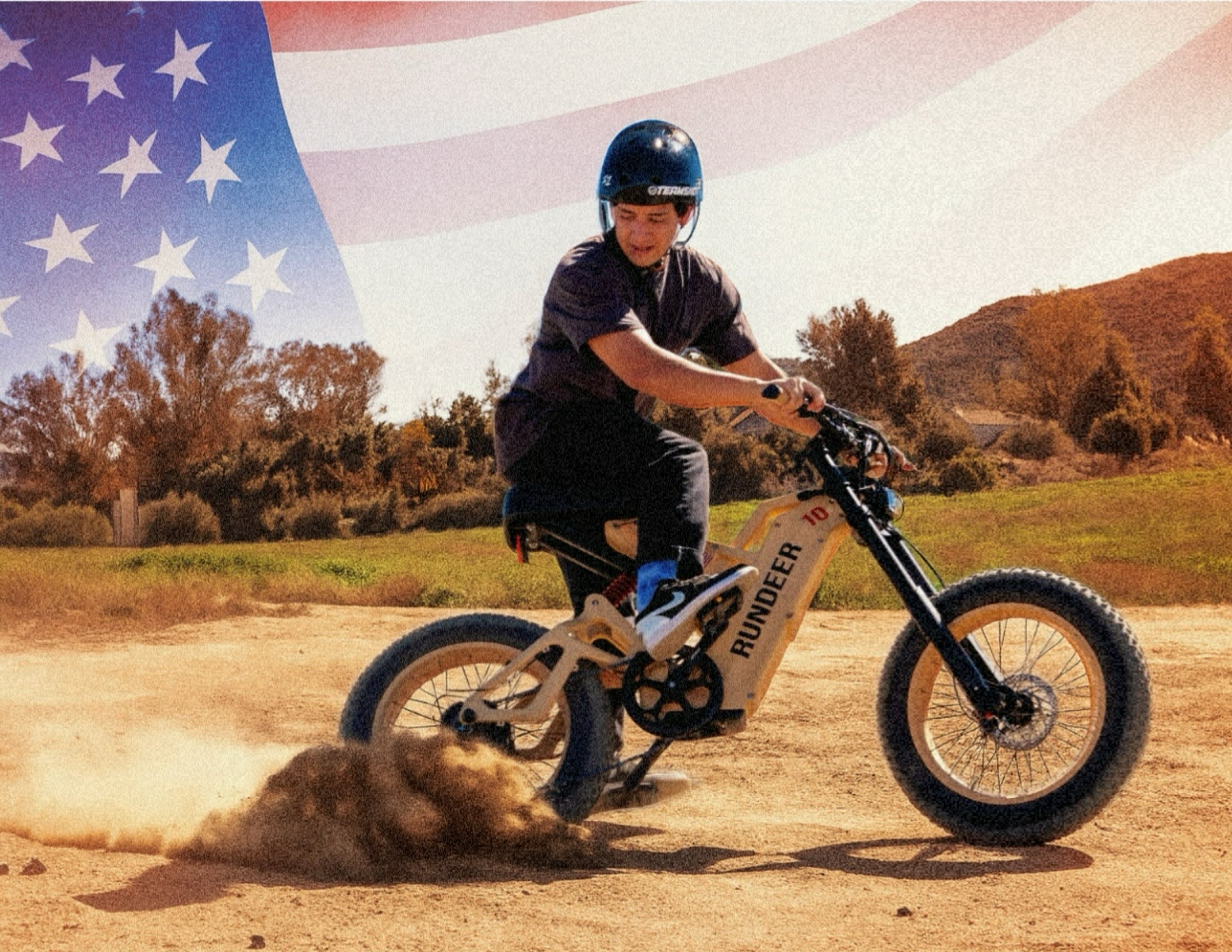

Electric Bikes for Kids Ages 8–14: A Parent's Safety & Sizing Guide
Quick Answer / TL;DR
If you are researching an electric bike kid 6-13 years old, the answer comes down to three non-negotiables: correct fit, appropriate speed limits, and pedal-assist-only operation. The AAP advises that children under 12 should not ride any motorized device faster than 10 mph, and recommends only Class 1 pedal-assist e-bikes for ages 12–15 (AAP / HealthyChildren.org). The CPSC recorded approximately 155,200 e-bike–related emergency department visits and 301 deaths from 2017 through 2024 (CPSC Micromobility Report 2017–2024). For a youth ebike, insist on TÜV-certified UL 2849 (full electrical system) and TÜV-certified UL 2271 (battery pack) compliance, an aluminum frame under 40 lb, and a 3-speed assist mode so you can cap your child's top speed by age. Never buy a throttle-equipped e-bike for a child—a pedal-assist-only design ensures the motor stops the instant pedaling stops, eliminating accidental acceleration.
What Size Electric Bike Is Right for Your Child's Age?
Size is the single most important safety variable. An e-bike that is too tall or too heavy forces poor posture and panic stops—exactly the scenarios that lead to fractures, head injuries, and internal trauma in record numbers (Children's Hospital of Orange County, 2024). Unlike adult bikes measured by frame size, kids' bikes are measured by wheel diameter (Trek Bikes Kids' Buyer's Guide).
Safety Sizing Chart: Height vs. Wheel Size vs. Frame Fit
| Child's Height | Recommended Wheel Size | Approximate Frame Size | Age Range | Key Fit Check |
|---|---|---|---|---|
| 4'0"–4'5" (122–135 cm) | 20" | 11"–12" (low-step) | 8–10 years | Ball of both feet on ground when seated |
| 4'3"–4'9" (130–145 cm) | 20" | 12"–13" (low-step) | 10–12 years | Slight knee bend at bottom of pedal stroke |
| 4'7"–5'3" (140–160 cm) | 24" | 13"–14" | 10–12 years | Can stand over top tube with 1"–2" clearance |
| 5'0"–5'7" (152–170 cm) | 24"–26" | 14"–15" | 12–14 years | Full flat-foot stop; arms relaxed on bars |
Critical rule: Never "size up" hoping a child will grow into the bike. An oversized e-bike is harder to control, especially at motor-assisted speeds. A 20-inch-wheel e-bike fitting 4'3"–5'7" (130–170 cm) riders—covering ages ~6–13—offers the longest usable span without compromising fit (RoSPA Bike Sizing Guide).
 Electric Bike Speed Limits for Kids by Age
Speed is the strongest predictor of injury severity. The CPSC's 2024 special study found that 15% of injured e-bike riders were traveling at 20 mph or higher, and motor vehicle collisions accounted for 170 of 310 reported e-bike fatalities (CPSC Micromobility Report 2017–2024). A JAMA Surgery study documented a 30-fold increase in e-bike injuries and 43-fold increase in hospitalizations between 2017 and 2022. For children, e-bike injuries result in hospitalization at 2.4 times the rate of pedal-bike injuries (Goodman et al., Surgery Open Science 2023).
Ages 8–10: Maximum Recommended Speed ≤ 10 MPH
The CPSC and AAP are aligned: children ages 9–12 should not operate any product faster than 10 mph (AAP / HealthyChildren.org). At 8–10 years old, hazard-recognition speed and peripheral vision are still maturing. A child traveling 12 mph covers 17.6 feet per second—faster than most young riders can scan and react. Use the lowest assist mode only (often labeled "Green" or "Eco," capped at ~10 mph). Ride on closed courses, parks, or separated bike paths—never on roads with vehicle traffic.
Ages 10–12: Maximum Recommended Speed ≤ 16 MPH
By 10–12, coordination and traffic awareness improve, but impulse control and risk assessment are still developing. The AAP recommends only Class 1 pedal-assist e-bikes for ages 12–15 (AAP / HealthyChildren.org). For an ebike kid 10-14, set the assist to mid-level (~16 mph cap) and require a helmet on every ride. Practice emergency stops and hand signals before road-adjacent riding. Note: 97.3% of injured pediatric e-bike riders were not wearing a helmet (Goodman et al., Surgery Open Science 2023).
Ages 12–14: Maximum Recommended Speed ≤ 20 MPH
For older tweens and teens—a common search for ebike kid 12-14—20 mph (Class 1 limit) is the maximum responsible assist speed. Some states allow Class 1 operation on bike lanes, but many restrict Class 2 and Class 3. Illinois will require riders to be at least 15 for Class 1/2, and 16 with a license for Class 3 effective January 2027 (OSF HealthCare, 2026). Prioritize graduated exposure: start at 16 mph, then open 20 mph only after consistent safe riding. The AAP recommends children under 16 not operate devices over 20 mph (AAP via CHKD).
Age-Based Speed Recommendation Table
| Age Group | Max Assist Speed | Assist Mode | Where to Ride | Helmet Standard |
|---|---|---|---|---|
| 8–10 years | ≤ 10 mph | Low / Green | Parks, closed courses, separated paths only | CPSC bicycle helmet (≤ 20 mph rated) |
| 10–12 years | ≤ 16 mph | Medium / Yellow | Bike lanes, neighborhood streets with supervision | CPSC bicycle helmet |
| 12–14 years | ≤ 20 mph | High / Red | Bike lanes, streets with traffic awareness training | CPSC bicycle helmet; consider MIPS or DOT for road riding |
Is an Electric Bike Safe for a 10-Year-Old?
Parents searching is electric bike safe for kids deserve a direct, evidence-based answer: it depends entirely on the bike, the speed, and the child's readiness. The CPSC does not recommend e-bikes for children under 9. For ages 9–12, the CPSC and AAP both advise that no child should operate anything exceeding 10 mph (CPSC / AAP via HealthyChildren.org). Since most e-bikes on the market reach 20 mph or more, a stock Class 1 or Class 2 e-bike is too fast for an unmodified 10-year-old without a speed-limiting assist mode.
The injury data underscores the risk. A 2026 Truveta Research analysis of emergency department records found that e-bike and e-scooter injury-related ED visits among children and adolescents increased 7.5-fold between 2023 and May 2026, with 35.4% of all injuries involving the head or neck and 6.9% involving traumatic brain injury (Truveta Research, July 2026). At Penn State Health Children's Hospital, doctors treated more kids for e-bike and e-scooter injuries in 2025 alone than in the prior three years combined (Penn State Health News, October 2025).
So, is an electric bike safe for kids aged 10? It can be—if you choose a pedal-assist-only model with a speed cap at 10 mph, if your child has strong basic cycling skills, and if you enforce helmet use and supervised riding. A throttle-equipped e-bike that surges to 20 mph at the twist of a grip is not safe for a 10-year-old.
Key Safety Features Every Youth Ebike Must Have
When you shop for a youth ebike, treat the following as a non-negotiable checklist—not a nice-to-have list.
-
Pedal-assist only (no throttle). A throttle allows the bike to accelerate without pedaling, which eliminates the "stop pedaling = stop motor" safety net. This is the single most important design choice for a child's e-bike. The AAP recommends only Class 1 (pedal-assist-only) e-bikes for riders under 16 (AAP / HealthyChildren.org).
-
TÜV-certified UL 2849 compliance. This standard tests the entire electrical system—battery, motor, charger, controller, wiring, and connectors—as a single unit, including overcharge, short-circuit, thermal cycling, and vibration tests (UL Solutions). New York City's Local Law 39 mandates UL 2849 (or equivalent NRTL certification) for any e-bike sold or leased in the city (NYC Council / UL Solutions).
-
TÜV-certified UL 2271 compliance. This standard covers the battery pack itself—cell spacing, BMS overcurrent shutoff, thermal runaway propagation resistance, and flame-retardant casing. UL 2849 requires the battery to meet UL 2271, but dual certification from TÜV provides an additional layer of independent verification (UL Solutions).
-
3-speed assist modes with graduated speed caps. You must be able to limit your child's top assisted speed. A Green/Yellow/Red system (for example, ≤ 10 mph / ≤ 16 mph / ≤ 20 mph) lets you start conservatively and unlock speed only as skill and maturity develop.
-
Aluminum frame under 40 lb. A 50 lb e-bike is extremely difficult for an 80 lb child to pick up after a fall. Stay under 40 lb; aim for 35 lb or less.
-
Disc brakes—hydraulic preferred. E-bikes carry more momentum at higher speeds. Mechanical discs are acceptable for lighter configurations; hydraulic brakes provide better modulation and stopping power, especially for heavier riders.
-
Front suspension. A dual-shoulder hydraulic fork absorbs impacts from curbs, potholes, and gravel that could jar a child's wrists and cause a loss-of-control crash.
-
Proper lighting and reflectors. The CPSC's special study found that 10% of e-bike injury victims reported visibility issues, and of those riding in dark conditions, only 44% were using lights or reflective gear (CPSC Micromobility Report 2017–2024). Integrated front and rear LED lights are essential.
-
7-speed drivetrain. Multiple gears let your child adjust effort to terrain, reducing the temptation to rely solely on motor power.
Best Electric Bike for Kids Ages 8–14
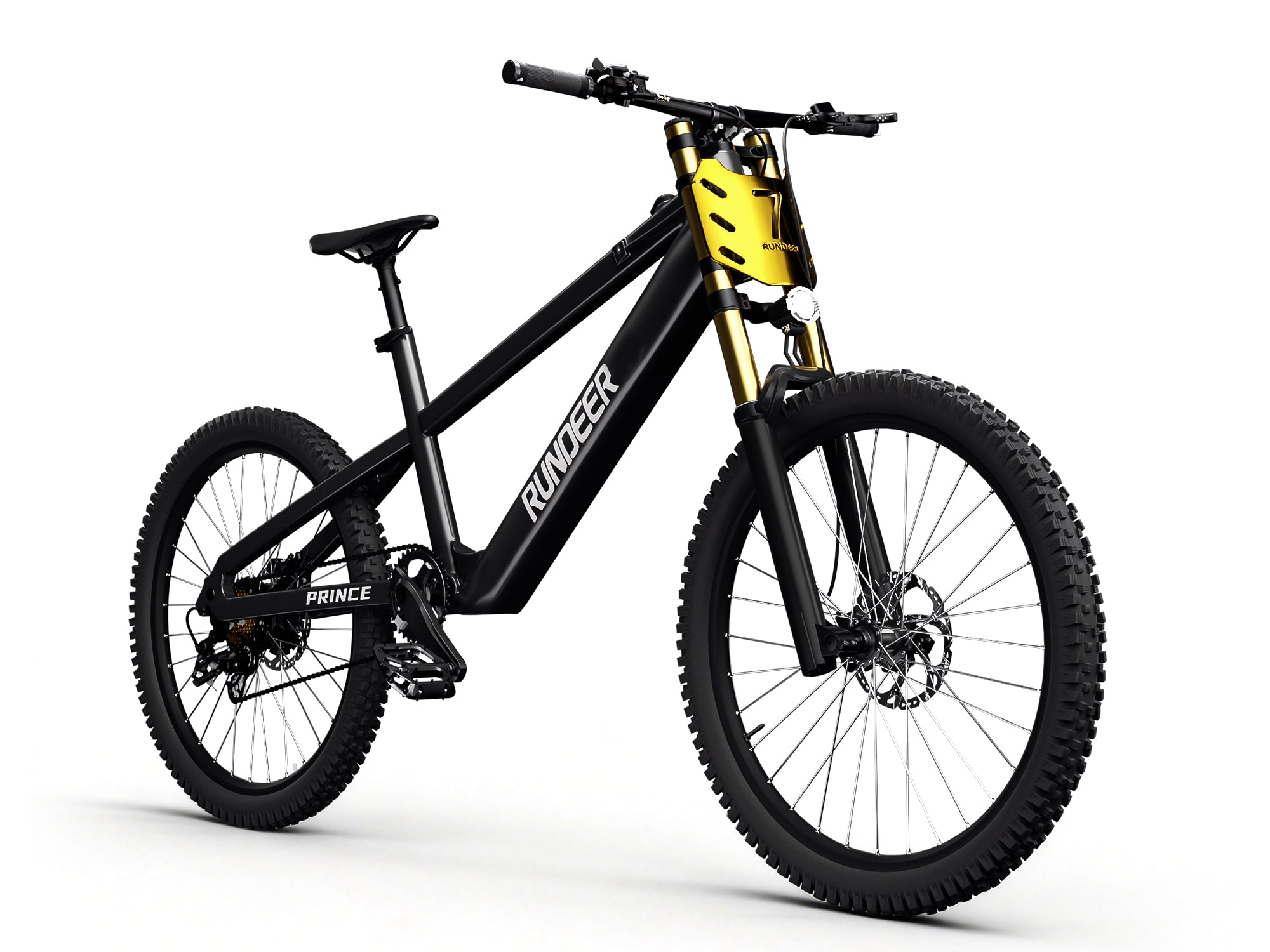
After evaluating the safety criteria above, one model that systematically checks every box is the RUNDEER Prince—a purpose-built youth ebike designed for riders ages 7–14.
| Specification | Detail |
|---|---|
| Recommended Age | 7–14 years |
| Rider Height Range | 4'3"–5'7" (130–170 cm) |
| MSRP | White/Pink/Red: $599.99 · Black: $699.99 |
| Curb Weight | 35 lb (16 kg) |
| Max Payload | 240 lb (108 kg) |
| Motor | 250W rated, pedal-assist only (no throttle) |
| Max Speed | 20 mph (32 km/h) |
| Assist Modes | Green ≤ 10 mph · Yellow ≤ 16 mph · Red ≤ 20 mph |
| Max Range | 32 miles (50 km) |
| Charge Time | 5 hours |
| Frame | Aluminum alloy, low-step |
| Tires | 20 × 2.0 in |
| Drivetrain | 7-speed Shimano |
| Front Suspension | Dual-shoulder hydraulic |
| Brakes | White/Pink/Red: mechanical disc · Black: hydraulic disc |
| Certifications | TÜV-certified UL 2849 + TÜV-certified UL 2271 |
The Prince's three assist modes mirror the age-based speed recommendations in this guide: Green mode (≤ 10 mph) for 8–10 year olds, Yellow mode (≤ 16 mph) for 10–12 year olds, and Red mode (≤ 20 mph) for experienced 12–14 year olds. At 35 lb, it is one of the lightest youth e-bikes available—critical for a child who may need to lift or steady the bike at a stop. The pedal-assist-only design (no throttle) means the motor disengages the instant pedaling stops, preventing accidental surges. The dual TÜV certification provides verified electrical-system and battery-level fire and shock protection—increasingly mandated by cities and states (NYC Local Law 39).
Pedal-Assist vs. Throttle: Why It Matters for Kids
This distinction is so critical for child safety that it deserves a full explanation.
A throttle e-bike (Class 2) can be propelled forward without pedaling—twist a grip and the motor drives the bike. For a child, this creates two hazards. First, accidental activation: a momentary grip squeeze while stationary launches the bike with no warning. Second, passive riding: a child coasting on throttle power gets no exercise benefit and no instinct to keep feet on pedals and hands on bars. When the throttle cuts off at 20 mph and the child is unprepared, the sudden loss of power can destabilize the bike.
A pedal-assist e-bike (Class 1) only provides motor power when the rider is actively pedaling. Stop pedaling = motor stops. This mirrors natural bicycle behavior and provides a built-in safety mechanism. Research has found that pedal-assist e-bikes behave like bicycles, whereas throttle-controlled devices behave more like motorcycles and should be regulated accordingly (Queensland Parliament Submission on E-Bike Regulation).
The AAP explicitly recommends only Class 1 (pedal-assist-only) e-bikes for children ages 12–15 (AAP / HealthyChildren.org). Pediatric trauma physicians have echoed this, noting that e-bikes traveling at 25–28 mph "become more like a motorcycle and not a bicycle" in terms of injury severity (Dr. Charles Aprahamian, OSF Children's Hospital, 2026).
For any parent asking about an electric bike for 10 year old or electric bike for 12 year old riders, the answer is the same: pedal-assist only, with a speed cap matched to the child's age and skill level. A throttle has no place on a child's e-bike.
Frequently Asked Questions
Q: What is the best electric bike for a 12 year old?
A: Look for a Class 1 (pedal-assist-only) e-bike with 20" or 24" wheels, an aluminum frame under 40 lb, a 3-speed assist system capped at 20 mph max, and dual UL 2849 / UL 2271 certification. The bike must fit your child's height—typically 4'7"–5'3" for a 12-year-old—with flat-foot stopping ability. Set the assist to the medium mode (approximately 16 mph) until your child demonstrates consistent safe riding.
Q: Is an electric bike safe for a 10 year old?
A: Only under strict conditions: the bike must be pedal-assist-only (no throttle), the assist mode must be locked to ≤ 10 mph, the child must wear a CPSC-rated helmet on every ride, and riding should be supervised and limited to bike paths or low-traffic areas. The CPSC and AAP both advise that children 9–12 should not operate any device faster than 10 mph (AAP / HealthyChildren.org).
Q: What size ebike should my kid ride?
A: Match the wheel size to your child's height, not age. For heights 4'0"–4'9", choose 20" wheels; for 4'7"–5'3", choose 24" wheels; for 5'0" and above, consider 26" wheels. Your child should be able to place the balls of both feet on the ground while seated, with a slight knee bend at the bottom of the pedal stroke. Never buy a size up.
Q: What does UL 2849 certification mean for a kids' e-bike?
A: UL 2849 is a system-level safety standard that tests the entire electrical system—battery, BMS, motor, controller, charger, and wiring—as an integrated unit. It includes tests for overcharge, short circuit, thermal cycling, vibration, and thermal runaway propagation. This goes far beyond battery-only certification. UL 2849 is increasingly required by law (e.g., NYC Local Law 39) and by major retailers like Amazon and Walmart (UL Solutions).
Q: Should I buy a throttle e-bike for my child?
A: No. The AAP recommends only Class 1 pedal-assist e-bikes for children under 16. A throttle allows the bike to surge forward without pedaling, creating a risk of accidental acceleration—especially dangerous for children with developing motor coordination. Pedal-assist ensures the motor stops when pedaling stops, providing an intuitive and immediate safety mechanism.
Q: How fast should an e-bike go for an 8 year old?
A: No faster than 10 mph in assisted mode. At 8 years old, a child's reaction time, hazard perception, and physical strength are still developing. Even 10 mph means covering nearly 15 feet per second. Restrict riding to parks, driveways, or closed courses with adult supervision and mandatory helmet use. For this age, consider whether a traditional pedal bike better serves your child's development.
Q: Can my kid ride an e-bike to school?
A: It depends on your state and local laws. At least 36 states use the three-class e-bike system, and age restrictions vary widely—some states have no minimum age for Class 1, while others (like Illinois, effective 2027) set minimums of 15 or 16. Check your state's vehicle code and your school district's policies. Regardless of legality, ensure your child has completed supervised riding practice and always wears a helmet (PeopleForBikes / State E-Bike Laws).