


Can Kids Ride E-Bikes to School? A Parent's Guide to Safe Commuting in 2026
The morning school run is changing. Across America, more kids are swapping the yellow bus and parental carpools for an e-bike—and the numbers are striking. The U.S. e-bike market is projected to grow from $3.78 billion in 2025 to $4.06 billion in 2026, with pedal-assist models accounting for nearly 80% of all sales, according to Mordor Intelligence. For families navigating this shift, the question isn't just whether children can ride an e-bike to school—it's how to ensure they do it safely, legally, and confidently.
This guide breaks down everything parents need to know about kids e-bike school commute in 2026, from evolving state laws and district policies to the safety gear, route planning, and e-bike features that matter most.
Why Kids E-Bike School Commute Is Booming in 2026
Several forces are converging to make the kids ebike school commute more popular than ever:
- Bus driver shortages persist: Many districts still face chronic transportation gaps, pushing families toward self-managed alternatives.
- Environmental awareness: Families increasingly choose low-carbon commuting options for short trips under five miles.
- E-bike technology has matured: Lighter frames, adjustable power modes, and longer battery ranges now make e-bikes practical for children as young as six.
- Cost efficiency: A one-time e-bike purchase replaces months of ride-shares, gas, and bus fees.
- Health and independence benefits: Beyond logistics, e-bike commuting gives children a sense of autonomy and responsibility. The physical effort required by pedal-assist models—especially Class 1 bikes that only power up when the rider pedals—ensures kids still get meaningful exercise, unlike throttle-driven alternatives that do the work for them. For many families, the daily ride has become a bridge between sedentary screen time and outdoor activity.
The pedal-assist segment dominates at 79.55% of the market—and that's not coincidental. Pedal-assist e-bikes, where the motor only engages when the rider pedals, are inherently safer for children than throttle-driven models. They require active physical engagement, giving young riders more natural control over acceleration and speed.
E-Bike School Rules: State Laws and District Policies in 2026
Understanding e-bike school rules starts with the three-class system used by most U.S. states:
| Class | Max Speed | Pedal-Assist | Throttle | Typical Age Requirement |
|---|---|---|---|---|
| Class 1 | 20 mph | Yes | No | Often 12+ (varies by state) |
| Class 2 | 20 mph | Yes | Yes | Often 14+ (varies by state) |
| Class 3 | 28 mph | Yes | No | Usually 16+ with license |
Most states permit children to ride Class 1 e-bikes, but the legal landscape is shifting quickly—and 2026 has brought major changes.
Washington State: SSB 6110
Effective June 11, 2026, Washington's SSB 6110 reclassifies any e-bike capable of exceeding 20 mph as an electric motorcycle, which requires a driver's license. Riders under 15 are prohibited from operating these higher-speed vehicles entirely. The law sends a clear message: if an e-bike can go faster than 20 mph, it is no longer a bicycle—it is a motor vehicle subject to licensing requirements (KIRO7).
Illinois: Stricter Age Limits Coming
Illinois is taking an even firmer stance. A new law effective January 2027 will set a minimum age of 15 for Class 1 and Class 2 e-bikes (both limited to 20 mph). Class 3 riders will need a driver's license and must be at least 16 years old (977wmoi.com). Families in Illinois should begin preparing now—training, route selection, and equipment choices should all align with these incoming requirements.
Federal Action: CPSC's 2026 Safety Proposal
In June 2026, the CPSC proposed a new federal safety rule under 16 CFR 1265 that would make UL 2849 certification mandatory rather than voluntary. UL 2849 is the comprehensive safety standard covering entire e-bike electrical systems—batteries, chargers, motor controllers, and wiring. The proposal responds to alarming safety data: between 2017 and 2024, the CPSC recorded 310 deaths and 155,200 emergency department visits linked to e-bike incidents (CPSC).
For parents, this means choosing an e-bike with UL 2849 certification is no longer optional—it's becoming the legal baseline. Models that carry TÜV-certified UL 2849 compliance have passed rigorous third-party safety testing of their battery and electrical systems, giving families verifiable assurance that the product meets the highest electrical safety standards.
School District Policies: Training Before Parking
E-bike school rules extend beyond state law. Many school districts now implement their own requirements for students who ride e-bikes to school. According to the AAP, some districts mandate completion of an e-bike safety training program before issuing a campus parking permit (healthychildren.org). Common district-level rules include:
- Registration and tagging of student e-bikes
- Designated secure parking areas with camera coverage
- On-campus speed limits (often 5–8 mph)
- Mandatory helmet policies enforced by school staff
Contact your school administration before the academic year begins to understand what's required.
Kids E-Bike Safety Tips: What Every Parent Should Know
The AAP's 2026 Advisory
On July 15, 2026, the American Academy of Pediatrics issued a sobering advisory: e-bike accidents have become the leading cause of emergency room visits among school-age children. The AAP's key recommendation was that standard bicycle helmets are not sufficient for e-bike riders. Parents should invest in CPSC-certified, high-quality helmets designed to withstand higher-speed impacts (healthychildren.org).
The AAP also called for broader systemic change. Beyond individual parent action, the organization urged schools and local governments to invest in protected cycling infrastructure along common school commute routes, and to incorporate e-bike safety education into school health curricula. The message was clear: keeping kids safe on e-bikes is a shared responsibility that extends beyond the home.
OSF HealthCare: "An E-Bike Is Not a Toy"
In July 2026, OSF HealthCare physicians went public with a direct warning: an e-bike is not a toy. Their clinical observations identified several dangerous patterns in children's riding behavior:
- Poor speed judgment: Children struggle to assess how fast they're traveling relative to surrounding traffic, pedestrians, and road conditions.
- Gaps in road-rule knowledge: Many young riders don't understand right-of-way, yield requirements, or proper lane positioning.
- Sensory impairment at night: Riding after dark in dark clothing while wearing earbuds dramatically increases collision risk.
The physicians emphasized that children lack the developmental maturity to process speed, distance, and risk at the velocities e-bikes can reach. Parents must treat e-bike riding as a learned skill that requires structured training—not simply supervised playtime (977wmoi.com).
Essential Safety Gear Checklist
Before your child rides an e-bike to school, assemble this gear:
- CPSC-certified helmet rated for e-bike speeds—not a basic bike helmet
- High-visibility vest or jacket, especially for dawn and dusk commutes
- Front white light and rear red light, both with flashing modes
- Wheel and pedal reflectors for 360-degree visibility
- A bell or horn to alert pedestrians and other cyclists
- Closed-toe shoes with non-slip soles—never sandals or Crocs
Additionally, consider investing in e-bike-specific gloves with padded palms to improve grip and protect hands during a fall, and brightly colored backpack covers that make your child visible from all angles, especially during the darker winter mornings when many students head to school before sunrise.
Teach These Riding Habits Early
Beyond gear, instill these non-negotiable riding habits:
- Always ride in the same direction as traffic, never against it
- Use hand signals before turning or stopping
- Make eye contact with drivers at intersections before proceeding
- Never wear headphones or earbuds while riding
- Dismount and walk the bike across busy intersections when unsure
How to Ride an E-Bike to School: Route Planning Guide
Route planning is one of the most powerful—and most overlooked—tools for safe kids e-bike commuting. A well-chosen route can eliminate most risk factors before your child ever leaves the driveway.
Step 1: Map a Bike-Optimized Route
While Google Maps offers a bicycle routing mode, dedicated cycling apps like Komoot and TrailLink often surface quieter, safer alternatives. Prioritize:
- Protected bike lanes physically separated from vehicle traffic
- Low-speed residential streets with minimal intersections and low daily traffic volumes
- School zone routes staffed by crossing guards during morning and afternoon peak hours
- Shared-use paths or greenways that bypass major arterial roads entirely
Step 2: Ride the Route Together—at Least Three Times
Before sending your child out alone, ride the full route together multiple times. During these practice rides, identify:
- Blind driveways and alleyways where cars may emerge without warning
- High-speed intersections without traffic signals or stop signs
- Railroad crossings with gap hazards that can trap narrow tires
- Stretches with poor lighting during early morning hours in winter months
- Construction zones or road closures that may alter the route mid-year
- Seasonal hazards: wet leaves in autumn, ice patches in winter, and sun glare during early morning rides in spring—all of which can dramatically change the safety profile of a route depending on the time of year
Step 3: Build a Backup Plan
What happens if the battery dies, a tire goes flat, or weather turns dangerous? Your child should know:
- Your phone number and how to reach you from any point on the route
- The location of the nearest safe stopping point—a fire station, public library, or trusted neighbor's home
- That walking the bike is always an acceptable option if conditions feel unsafe
Step 4: Coordinate with Other Families
Consider forming a "bike train"—a group of children riding together with one or more adults accompanying them. Group riding increases visibility, provides peer accountability for safe behavior, and builds confidence for younger riders.
Choosing the Best E-Bike for Kids School Commute
Not all e-bikes are suitable for children. When evaluating the best ebike for kids school commutes, focus on these criteria:
UL 2849 Certification: The Non-Negotiable Standard
With the CPSC's 2026 proposal to make UL 2849 mandatory, purchasing an uncertified e-bike is a risk parents should not take. This certification tests the entire electrical system for fire, explosion, and electrical hazards. The RUNDEER Prince series, for instance, carries TÜV-certified UL 2849 compliance—ensuring its 36V battery, charger, and motor controller meet the most rigorous safety benchmarks available.
Class 1 Pedal-Assist: The Right Category for Children
Class 1 e-bikes provide motor assistance only when the rider pedals and cap at 20 mph. This is the category most states allow for younger riders, and it aligns with the pedal-assist segment that dominates 79.55% of the U.S. market. Without a throttle, the e-bike cannot accelerate on its own—the child's pedaling determines the pace, which provides a natural speed governor.
Adjustable Speed Modes
The best e-bike for kids school commutes is one that grows with the rider. Look for models with multiple speed modes that parents can lock. For example, the RUNDEER Prince offers three modes:
| Mode | Max Speed | Best For |
|---|---|---|
| Green | ≤ 10 mph | Beginners ages 6–8, busy pedestrian areas |
| Yellow | ≤ 16 mph | Intermediate riders, mixed-use paths |
| Red | ≤ 20 mph | Confident riders ages 10+, open bike lanes |
Starting in Green mode for a 6-year-old and gradually unlocking higher modes as skills develop is the safest progression.
Weight and Handling
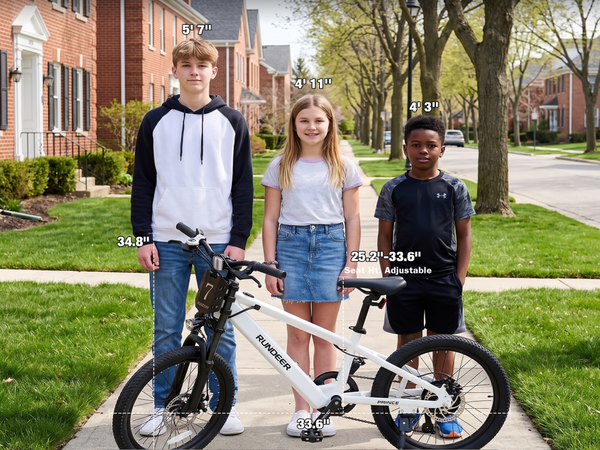
A heavy e-bike is harder for children to control at low speeds, when starting from a stop, or when maneuvering through tight spaces. Look for models under 40 pounds. The Prince series weighs just 35 pounds (16 kg), making it manageable for children across the 6–13 age range.
Battery Range and Charging
A typical school commute of 2–5 miles each way requires minimal battery capacity, but margin matters. A battery rated for 30+ miles of range ensures your child won't be stranded if they forget to charge overnight or take an unexpected detour. A 5-hour charge time means an overnight plug-in is always sufficient.
The Hidden Risks: CPSC Data and Medical Warnings
310 Deaths, 155,200 ER Visits
The CPSC's data from 2017 to 2024 is sobering: 310 e-bike-related deaths and 155,200 emergency department visits. While not all incidents involved children, the rate is accelerating as more young riders take to the roads—and as higher-speed, uncertified products continue to enter the market.
The 20 mph Threshold
Research from Rady Children's Health found that speeds exceeding 20 mph significantly increase the risk of traumatic injuries in young riders. This finding reinforces the case for Class 1 e-bikes capped at 20 mph and warns against modified or throttle-equipped bikes that can exceed this threshold (KIRO7).
California's Crackdown on Speed E-Bikes
In a move signaling broader regulatory tightening, California led an effort that resulted in Amazon halting sales of e-bikes capable of exceeding legal speed limits. These products, marketed as e-bikes but capable of 28+ mph, effectively operated as unlicensed motor vehicles—and ended up in the hands of untrained consumers (CBS News).
The lesson for parents: purchase only from reputable manufacturers who clearly state their e-bike's classification, and avoid any product that can be easily modified to exceed 20 mph. The California crackdown also highlights a broader truth—regulators are catching up to a market that has outpaced safety standards for years. Parents who choose certified, properly classified e-bikes now will be ahead of the compliance curve as federal and state rules continue to tighten through 2026 and beyond.
Frequently Asked Questions
- At what age can my child ride an e-bike to school?
- It depends on your state. Most states allow children 12 and older to ride Class 1 e-bikes, but new laws are raising the bar. Illinois will require riders to be at least 15 for Class 1 and Class 2 beginning in January 2027. Washington's SSB 6110 prohibits riders under 15 from operating any e-bike capable of exceeding 20 mph. Always check your local state law and school district policy before allowing your child to ride.
- What is the safest type of e-bike for a school commute?
- Class 1 pedal-assist e-bikes are the safest and most widely permitted category for children. They cap at 20 mph, have no throttle, and only assist when the rider pedals. Look for a model with UL 2849 certification, adjustable speed modes, and a weight under 40 pounds. The combination of pedal-assist operation and parent-controlled speed limits provides the best balance of safety and independence.
- Does my child need a special helmet for e-bike riding?
- Yes. The AAP's 2026 advisory specifically warns that standard bicycle helmets are insufficient for e-bike riders. Invest in a CPSC-certified helmet rated for higher-speed impacts. A quality e-bike helmet offers better impact absorption, extended coverage at the back of the head, and improved ventilation for longer rides at assisted speeds.
- Can my child's school ban e-bikes?
- School districts generally have the authority to set their own policies regarding e-bike use on campus. Some require registration, mandatory safety training, or designated parking. A growing number of districts, as the AAP noted in 2026, require students to complete an e-bike safety course before issuing a campus parking permit. Check with your school administration for specific rules.
- How fast should my child's e-bike go?
- For children ages 6–8, a maximum of 10 mph is appropriate. Intermediate riders (ages 9–11) can handle up to 16 mph. Confident, experienced riders (ages 12+) can use the full 20 mph Class 1 limit—but only on appropriate routes with protected infrastructure. The key is choosing an e-bike with adjustable speed modes that parents can lock based on the child's age, experience, and route conditions.
- What should I do if my state hasn't passed specific e-bike laws?
- Even without specific state legislation, follow best practices: choose a Class 1 pedal-assist e-bike with UL 2849 certification, require a CPSC-certified helmet, enforce speed limits through adjustable modes, and ensure your child completes a basic riding safety course. You should also check whether your city or county has local ordinances, and always comply with your school district's policies. When in doubt, err on the side of caution.