


Kids E-Bike Weight: Why It Matters for Safety, Handling, and Transport
When parents start shopping for a children's electric bike, most focus on motor power, top speed, and battery range. But there is one specification that often gets overlooked — and it may be the single most important factor for your child's safety: kids ebike weight.
The U.S. e-bike market is growing rapidly, projected to expand from $3.78 billion in 2025 to $4.06 billion in 2026, according to Mordor Intelligence. As more families buy e-bikes for kids ages 6 to 13, understanding how weight affects every aspect of the riding experience — from stopping distance to maneuverability to simply loading the bike into a car trunk — becomes essential.
This guide breaks down everything parents need to know about ebike weight children should handle, how different frame materials change the equation, and what weight range actually makes sense for young riders.
Why Kids E-Bike Weight Is a Safety Issue
Weight is not just a number on a spec sheet. It directly impacts three critical safety dimensions: handling, fall recovery, and braking distance.
Handling and Steering Control
A heavier bike requires more physical effort to steer, especially at low speeds or when making tight turns. For a child weighing 60 to 100 pounds, piloting a 50-pound e-bike means nearly half their body weight is underneath them in the form of machinery. That ratio makes low-speed maneuvers — like navigating a driveway apron or a narrow bike path — significantly harder.
The American Academy of Pediatrics (AAP) notes that e-bikes are "faster, heavier and more difficult to manage than regular bicycles," and that children need "additional skills, maturity and safety training" before riding one. When a bike is too heavy for its rider, the child may struggle to correct a wobble or avoid an obstacle, increasing the likelihood of a crash.
Fall Recovery and Tip-Over Risk
When a traditional bicycle tips over, a child can usually catch it or pick it back up quickly. With a kids electric bike weight of 40 pounds or more, the situation changes dramatically. If the bike leans past the balance point, a young rider may not have the upper-body strength to hold it up. The result is a tip-over that can pin a leg, cause a shoulder strain, or lead to the bike landing on top of the child.
Industry guidelines suggest that a child's bike should weigh no more than 25% of their body weight. For a 70-pound child, that means the bike should ideally be under 17.5 pounds — a target that is challenging for any e-bike with a motor and battery. This is why understanding how heavy kids ebike models actually are matters so much: the closer you can get to a reasonable weight-to-rider ratio, the safer the experience.
Braking Distance and Stopping Power
Physics is unforgiving: more mass means more momentum, and more momentum means longer stopping distances. A 50-pound e-bike carrying a 80-pound child traveling at 15 mph carries significantly more kinetic energy than a 20-pound traditional bike at the same speed. If the brakes are not sized appropriately for the extra weight, stopping distances increase — sometimes by several feet.
The Consumer Product Safety Commission (CPSC) reported approximately 155,200 emergency department visits and 301 deaths related to e-bikes from 2017 through 2024, according to their latest "Micromobility Products-Related Deaths, Injuries and Hazard Patterns" report. Motor vehicle crashes and loss-of-control issues were the top hazards. While not all of these incidents involved children, the data underscores how critical it is to match bike weight and speed to a rider's physical capabilities.
The AAP specifically recommends that children ages 9 to 12 should not operate any product that travels faster than 10 mph, and that riders 12 to 15 should only use Class 1 e-bikes (pedal-assist only, max 20 mph). These age-based guidelines are directly tied to a child's ability to manage the combined weight and speed of an e-bike.
How Heavy Should a Kids E-Bike Be? Understanding the Average Range
The kids electric bike weight landscape varies widely. Based on current market data, children's e-bikes typically fall into these weight categories:
| Weight Range | Examples | Typical Age Group |
|---|---|---|
| 7–17 lbs (3–8 kg) | Electric balance bikes (STACYC, Fiido Kidz) | Ages 3–7 |
| 20–35 lbs (9–16 kg) | Compact kids e-bikes, lightweight models | Ages 6–10 |
| 35–50 lbs (16–23 kg) | Full-size kids e-bikes with larger batteries | Ages 8–13 |
| 50+ lbs (23+ kg) | Folding and fat-tire models marketed to teens | Ages 12+ |
The average kids e-bike with a motor and battery weighs between 33 and 44 pounds (15–20 kg). That is a substantial range, and where a bike falls within it makes a real difference. A lightweight kids ebike in the 30-to-35-pound range is generally manageable for children aged 8 and up, while models pushing past 45 pounds can be difficult for smaller riders to handle safely.
One practical benchmark: if your child cannot lift the front wheel off the ground while standing beside the bike, the bike is likely too heavy for them to control confidently in an emergency.
Frame Materials: Aluminum vs. Magnesium vs. Steel
The frame is the single largest contributor to an e-bike's overall weight, and the material it is made from sets the baseline for everything else.
Steel Frames
Steel is the traditional choice for budget bicycles. It is strong, inexpensive, and easy to repair — but it is also the heaviest option. A steel-framed kids e-bike can easily exceed 50 pounds once you add a motor, battery, and larger tires. For young riders, steel frames are generally not recommended because the weight penalty is simply too high.
Aluminum Alloy Frames
Aluminum alloy — specifically 6061-T6 — is the most common frame material for mid-range e-bikes. It offers a good balance of strength, weight, and cost. With a density of approximately 2.70 g/cm³, aluminum is about 40% lighter than steel while maintaining solid structural integrity. Most lightweight kids ebike models in the 30-to-40-pound range use aluminum frames.
Aluminum also resists corrosion better than steel, making it suitable for kids who ride in wet conditions or leave their bikes outside. The main drawback is that aluminum is relatively stiff, transmitting more road vibration to the rider's hands and arms.
Magnesium Alloy Frames
Magnesium alloy is the lightest structural metal used in bicycle manufacturing. With a density of roughly 1.74 g/cm³, it is about 35% lighter than aluminum and 75% lighter than steel. Magnesium also has significantly higher vibration damping capacity — up to ten times that of aluminum — which means a smoother ride on rough surfaces.
The trend toward magnesium is growing. In July 2026, Tesla launched a Balance Bike for Kids featuring a lightweight magnesium frame, demonstrating that even non-cycling brands recognize the material's advantages for children's products. While magnesium frames are more expensive to manufacture and less common in budget e-bikes, they represent the future of lightweight kids ebike design.
What This Means for Parents
When evaluating a kids e-bike, check the frame material before anything else. An aluminum frame is the practical sweet spot for most families — light enough for kids to handle, durable enough for daily use, and affordable enough to fit most budgets. Magnesium is worth considering if weight is your top priority and budget allows.
How E-Bike Weight Affects Range and Battery Life
There is a direct relationship between bike weight and battery range, and it is not always intuitive. Here is how it works:
Heavier bikes consume more energy per mile. The motor has to work harder to move more mass, which drains the battery faster. A 50-pound e-bike may see 15 to 20% less range than an otherwise identical 35-pound bike with the same battery — simply because more energy goes into moving the extra weight.
However, bike weight is only part of the equation. Rider weight, terrain, assist level, and tire pressure all play major roles. A 35-pound bike carrying a 120-pound teenager up a hill will still consume more battery than a 50-pound bike carrying a 60-pound child on flat ground.
For context, a well-designed kids e-bike with a 36V 10Ah battery (360 watt-hours) and a total weight of around 35 pounds can typically achieve 25 to 32 miles of range on pedal-assist mode. That same battery on a 45-pound bike might see range drop to 20 to 26 miles under similar conditions.
The takeaway: if range matters to your family — for school commutes, long trail rides, or camping trips — a lightweight kids ebike will go farther on the same charge.
Helping Kids Manage a Heavier E-Bike
Even with a well-chosen bike, there will be moments when your child needs to handle the bike without motor assistance — pushing it up a hill, carrying it up porch steps, or lifting it into a vehicle. Here are practical strategies:
Parking and Kickstand Technique
Teach your child to always park on level ground with the kickstand fully deployed. On a slope, a heavy e-bike can roll off the kickstand and fall. Show them how to lean the bike toward the kickstand side before letting go, so the weight settles onto the stand rather than pulling away from it.
Pushing and Walking the Bike
When the battery dies or a hill is too steep, kids need to walk the bike. Practice this skill before it becomes necessary. Have your child stand on the left side, grip both handlebars, and lean the bike slightly toward themselves. For heavier bikes, suggest they use the saddle to push from behind when going uphill — it gives better leverage than the handlebars alone.
Loading Into a Car or SUV
For parents, loading a 35-to-50-pound e-bike into a vehicle is a two-person job if the bike does not fold. If your child is old enough (10+), teach them to help by guiding the rear wheel while you lift the front. Removable batteries are a major advantage here — taking the battery out can reduce the bike's weight by 5 to 8 pounds, making it significantly easier to lift.
Lifting After a Fall
This is the scenario most parents do not think about until it happens. Practice the technique with your child: stand on the side opposite the fall, grip the handlebar and the seat or frame, and use leg muscles (not back) to lift. If the bike is too heavy, teach them to call for help rather than risk injury.
Weight vs. Durability: Finding the Right Balance
Parents often assume that lighter means less durable. This is not necessarily true, but the relationship between weight and durability is worth understanding.
Steel is durable but heavy. A steel frame can take years of abuse and still function, but the weight makes it impractical for most kids.
Aluminum is light and durable enough for kids. Modern 6061-T6 aluminum frames undergo heat treatment that gives them excellent strength-to-weight ratios. They can withstand the drops, curb hops, and general rough handling that kids dish out.
Magnesium is lightest but requires care. While magnesium alloys have excellent impact resistance, they can be more susceptible to corrosion if the surface coating is scratched. For kids who are hard on their equipment, aluminum may be the more practical long-term choice.
The real durability concern with kids e-bikes is not the frame — it is the components. Motor mounts, battery enclosures, and wiring harnesses take the brunt of daily wear. A well-built 35-pound e-bike with quality components will outlast a poorly built 25-pound bike every time. Look for models with UL 2849 certification, which tests the entire electrical system — battery, charger, and motor — for fire and electrical safety.
Where 35 Pounds Sits in the Market
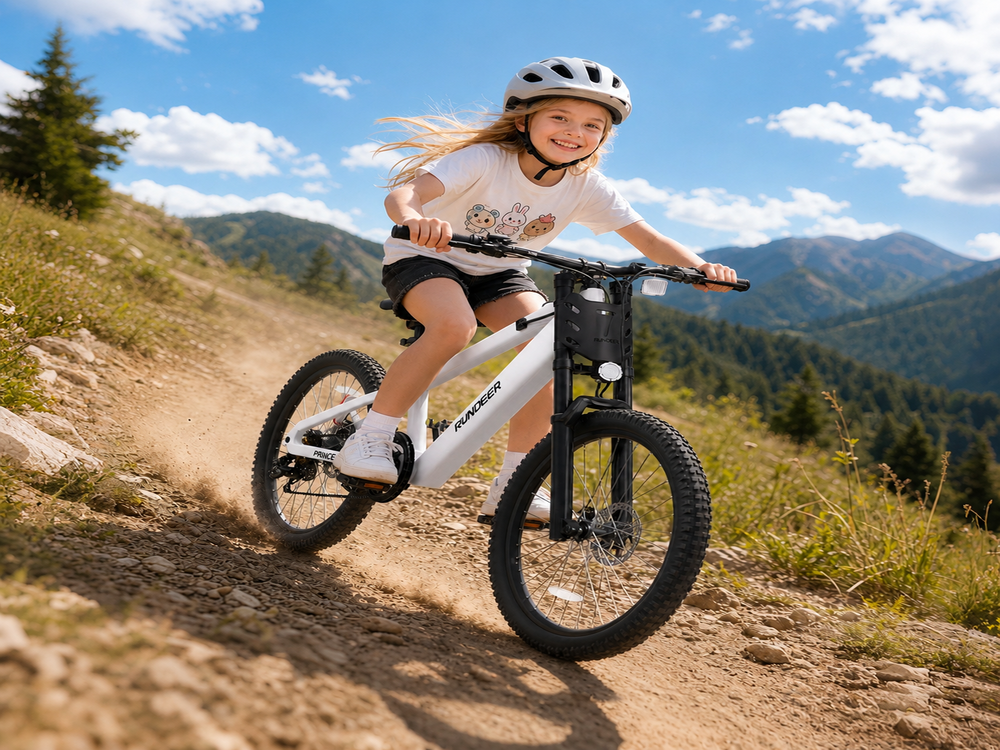
At 35 pounds (16 kg), the RUNDEER Prince occupies a notable position in the kids e-bike market. It is lighter than the majority of full-featured kids e-bikes, which typically range from 40 to 50 pounds, yet it still packs a 36V 10Ah battery, a 250W motor (500W peak), and a full 7-speed Shimano drivetrain.
Here is how 35 pounds compares to common market benchmarks:
| Bike Category | Typical Weight | Prince (35 lbs) Position |
|---|---|---|
| Electric balance bikes | 7–17 lbs | Heavier, but full-featured |
| Ultralight kids e-bikes | 20–30 lbs | Slightly heavier, more capable |
| Average kids e-bike | 33–44 lbs | At the lighter end of average |
| Heavy/folding kids e-bikes | 45–66 lbs | Significantly lighter |
For children aged 6 to 13 — the Prince's target age range — 35 pounds is a weight that most kids in the upper end of that range (10+) can manage for short carries and tip-over recovery, while younger riders (6–8) will need parental assistance for loading and lifting but can handle the bike fine while riding.
The pedal-assist-only design (no throttle) also contributes to safety at this weight. Without a throttle, the bike cannot accelerate on its own — the child must pedal to engage the motor, which gives them more control over speed and momentum. Combined with the three-tier speed limiting system (Green ≤10 MPH, Yellow ≤16 MPH, Red ≤20 MPH), parents can start younger riders on the lowest setting and gradually increase speed as skills and confidence grow.
The 20×2.0" tire size provides a stable footprint without adding excessive rotational weight, and the 240-pound maximum load capacity means the bike can grow with the child through their teenage years. With UL 2849 certification on the electrical system, the Prince meets recognized safety standards that are becoming mandatory in cities like New York.
FAQ: Kids E-Bike Weight
- How heavy is a typical kids e-bike?
- Most kids e-bikes with a motor and battery weigh between 33 and 44 pounds (15–20 kg). Ultralight models and electric balance bikes can weigh as little as 7 to 20 pounds, while larger folding and fat-tire models marketed to teens can exceed 50 pounds. For children aged 6 to 13, a weight of 30 to 38 pounds is generally considered a good balance of capability and manageability.
- What is the ideal weight ratio between a child and their e-bike?
- Industry guidelines suggest a bike should weigh no more than 25% of the rider's body weight. However, this guideline was developed for traditional bicycles and is difficult to achieve with e-bikes, which require motors and batteries. For e-bikes, a more practical target is to keep the bike under 50% of the rider's weight. A 70-pound child on a 35-pound bike is at 50% — manageable with practice, but requiring adult supervision for loading and lifting.
- Does a heavier e-bike brake slower?
- Yes. Braking distance increases with total mass (bike + rider). A heavier e-bike traveling at the same speed as a lighter one will require more distance to stop. This is why disc brakes — which provide stronger stopping power than rim brakes — are recommended for any e-bike weighing more than 30 pounds. The CPSC's data showing 155,200 e-bike-related emergency visits from 2017 to 2024 highlights the importance of adequate braking performance.
- How does frame material affect kids e-bike weight?
- Frame material is the largest single factor in an e-bike's weight. Steel is heaviest (and least common in quality kids e-bikes), aluminum alloy offers the best balance of weight, strength, and cost, and magnesium alloy is lightest but more expensive. Tesla's 2026 Balance Bike for Kids uses a magnesium frame, signaling the material's growing adoption in children's cycling products.
- Can a 6-year-old handle a 35-pound e-bike?
- While riding with motor assistance, most 6-year-olds can manage a 35-pound e-bike on flat terrain at low speeds, especially with speed limiting enabled. However, they will need help lifting, carrying, and loading the bike. Parents should use the lowest speed setting (ideally 10 MPH or below for this age group, per CPSC recommendations) and provide close supervision. The bike's pedal-assist-only design helps because the child controls acceleration through pedaling.
- Does bike weight affect battery range?
- Yes. Heavier bikes require more energy to move, which drains the battery faster. A 35-pound e-bike with a 36V 10Ah battery will typically achieve better range than a 45-pound bike with the same battery. Weight is one of several factors — along with rider weight, terrain, assist level, and tire pressure — that determine real-world range.
Conclusion
When choosing a kids e-bike, weight deserves the same attention as motor power, speed, and battery capacity. It affects safety, handling, transport, and even how far your child can ride on a single charge. The U.S. e-bike market's continued growth — projected to reach $4.06 billion in 2026 — means more options than ever, but also more responsibility for parents to choose wisely.
Look for a bike that balances capability with manageability: an aluminum frame, a total weight in the 30-to-38-pound range, pedal-assist only operation, speed-limiting features, and UL 2849 certification. Prioritize models that your child can physically handle — not just while riding, but when the motor is off and the bike needs to be pushed, parked, or loaded into a car.
The right weight makes the difference between a bike your child outgrows and one they master.