


E-Bike Incentive Programs: How Families Can Save on Kids' E-Bikes in 2026
The American e-bike market is on a remarkable upward trajectory. In 2025, the U.S. e-bike market reached $3.78 billion, and projections suggest it will hit $4.06 billion in 2026, climbing to $5.78 billion by 2031 with a compound annual growth rate (CAGR) of 7.32%, according to Mordor Intelligence. With that growth comes an expanding ecosystem of incentive programs designed to make e-bikes—and increasingly, kids' e-bikes—more accessible to families across the country.
If you're a parent considering an e-bike for your child, understanding the evolving landscape of ebike incentive programs could save your family hundreds of dollars. From federal tax credit discussions to local point-of-sale rebate programs, here's a comprehensive guide to what's available in 2026.
 The Current State of E-Bike Incentive Programs in 2026
A Record Number of Programs Across North America
A landmark report released in February 2026 by the Transportation Research and Education Center (TREC) at Portland State University found that there are now 118 active e-bike incentive programs across the United States and Canada. This represents a significant increase from prior years, reflecting growing recognition among policymakers that e-bikes are a viable, sustainable alternative to short-distance car trips.
The TREC report, which was supported in part by UL Standards & Engagement (ULSE), provides the most comprehensive snapshot to date of how cities, states, and utility companies are structuring their incentive offerings. These programs range from modest local rebates to substantial state-level subsidies, and many are now specifically designed to address barriers faced by low- and middle-income families.
Why E-Bike Adoption Matters for Families
The IRS has acknowledged e-bikes as a practical alternative to short-distance automobile travel. However, as noted on IRS.gov and corroborated by Mordor Intelligence, the upfront cost—typically ranging from $1,000 to $4,000—remains a key barrier to broader adoption. For families looking to purchase e-bikes for their children, this cost consideration is amplified, making incentive programs all the more critical.
From Post-Purchase Refunds to Point-of-Sale Discounts: The Evolution of E-Bike Rebate Programs
The Problem with the Old Model
In 2022, the majority of e-bike rebate programs operated on a post-purchase tax refund model. Participants had to pay the full price upfront and then wait—sometimes months—for a rebate or tax credit to arrive. This structure inherently favored households with the financial cushion to front the entire purchase price, creating a barrier for lower-income families who stood to benefit the most from e-bike adoption.
The Point-of-Sale Revolution
By 2025, the TREC report documented a significant shift: many programs transitioned to point-of-sale discounts, where the incentive is applied directly at the time of purchase. This means buyers see the savings immediately, reducing the financial strain of an upfront payment.
This evolution reflects a broader recognition of equity in program design. As the TREC report highlights, point-of-sale discounts remove the financial burden of waiting for reimbursement, making e-bike ownership accessible to families who cannot afford to tie up hundreds or thousands of dollars while waiting for a refund.
For parents exploring a kids ebike discount, this shift is particularly meaningful. Point-of-sale programs allow families to walk into a participating retailer or shop online and immediately see the reduced price—no waiting, no paperwork backlog, no uncertainty.
 The Federal E-Bike Tax Credit: Where Things Stand in 2026
Congressional Discussions and IRS Recognition
The concept of a federal ebike tax credit has been circulating in policy circles for several years. The IRS has recognized e-bikes as a legitimate transportation alternative, noting their potential to replace short-distance car trips. However, the upfront cost of $1,000–$4,000 remains a significant obstacle for many households, as documented by Mordor Intelligence and referenced on IRS.gov.
While a comprehensive federal tax credit for e-bikes has not yet been enacted into law, ongoing discussions in Congress suggest momentum is building. Advocates argue that a federal credit—similar to those available for electric vehicles—would dramatically expand access to e-bikes, including models designed for children and teens.
What a Federal Credit Could Mean for Kids' E-Bikes
If a federal ebike tax credit is eventually passed, it could apply to a wide range of e-bike categories, including youth models. For families, this would mean that the cost of purchasing a kids' e-bike could be partially offset through a tax filing, reducing the effective purchase price and making it easier to invest in a safe, certified e-bike for their child.
Until federal legislation is finalized, however, families should focus on the growing number of state and local programs that are already providing tangible savings.
 Safety Standards and E-Bike Purchase Incentive Eligibility: Why UL Certification Matters
The Growing Requirement for UL Certification
One of the most important trends documented in the TREC report is the increasing number of incentive programs that require e-bikes to meet specific safety standards—particularly UL certification. Many programs now mandate that e-bikes carry UL 2849 certification for the electrical system and UL 2271 certification for the battery pack before they qualify for any rebate or discount.
UL Standards & Engagement, which helped fund the TREC report, has been a vocal advocate for linking safety standards to incentive eligibility. The organization's involvement underscores the importance of ensuring that subsidized e-bikes meet rigorous safety benchmarks.
A Voice from the Safety Community
David McKnight, Vice President of UL Standards & Engagement, emphasized the critical connection between adoption growth and safety standards in the TREC report:
"As e-bike adoption grows, safety must grow alongside it. Requiring bicycles and lithium batteries to meet recognized safety standards helps ensure that products have been tested, certified, and designed with protection in mind."
This philosophy is increasingly reflected in program requirements. Families seeking an ebike purchase incentive should verify that the model they're considering carries the appropriate UL certifications. For example, the RUNDEER Prince kids' e-bike carries UL 2849 certification for its electrical system, meeting a key requirement that many incentive programs now enforce.
What Parents Should Look For
When evaluating a kids' e-bike for incentive eligibility, parents should check for:
- UL 2849 certification for the complete electrical system
- Compliance with local e-bike classification laws (Class 1, 2, or 3)
- Age-appropriate speed limits and safety features
- A manufacturer's warranty and transparent safety documentation
Equity and Accessibility: Who Benefits from E-Bike Rebate Programs?
Income-Based Eligibility
The TREC report reveals that a growing number of e-bike rebate programs now incorporate income limits, prioritizing subsidies for low- and moderate-income households. This equity-focused approach is designed to reduce transportation inequality by ensuring that the families who need affordable transportation options the most are the ones who receive the largest incentives.
For families considering a kids' e-bike, this means that eligibility—and the size of the discount—may depend on household income. Some programs offer tiered rebates, with higher-income households receiving a standard discount and lower-income households receiving an enhanced subsidy.
Why Equity Matters for Kids' E-Bikes
Transportation equity extends beyond adult commuters. Children in underserved communities often lack safe, reliable transportation to school, extracurricular activities, and community programs. E-bikes can bridge that gap, and incentive programs that prioritize equity help ensure that all children—not just those from affluent families—can benefit from this technology.
How Equity-Based Programs Are Structured
The TREC report identifies several common equity structures across the 118 programs it catalogued. Many use a sliding-scale model, where the rebate amount increases as household income decreases relative to the area median income (AMI). For example, a family earning below 80% of AMI might receive a substantially larger incentive than one earning between 80% and 200% of AMI. Some programs also offer additional bonuses for specific populations, such as veterans, students, or residents of designated underserved neighborhoods.
This targeted approach means that families who might otherwise struggle to afford a kids' e-bike could receive a meaningful portion of the purchase cost covered through an incentive. Parents are encouraged to research whether their local program includes income-based tiers and to gather necessary documentation—such as tax returns or proof of enrollment in qualifying assistance programs—before applying.
Kids' E-Bike Discount Programs: What Parents Need to Know
Understanding E-Bike Classifications for Youth Riders
Most e-bike incentive programs reference the three-class system used to regulate e-bikes in the United States:
- Class 1: Pedal-assist only, max speed 20 MPH
- Class 2: Throttle-assisted, max speed 20 MPH
- Class 3: Pedal-assist only, max speed 28 MPH
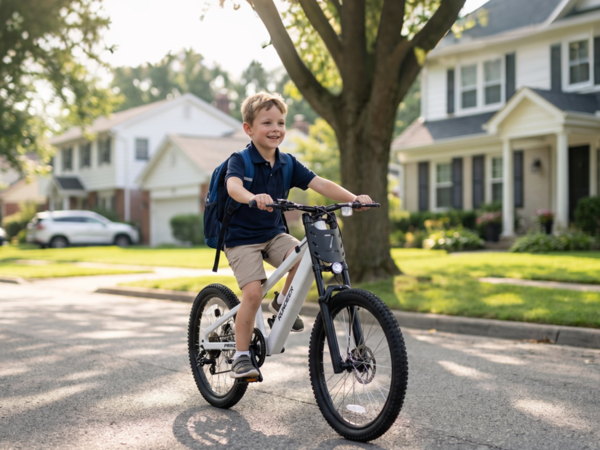
For kids' e-bikes, Class 1 models—pedal-assist only with no throttle—are generally the safest and most widely accepted. The RUNDEER Prince, for instance, operates as a pedal-assist-only e-bike with a maximum speed of 20 MPH and a three-speed gear system (Green ≤10 MPH, Yellow ≤16 MPH, Red ≤20 MPH), allowing parents to control the speed as their child builds confidence and skill.
Key Specs to Consider When Choosing a Kids' E-Bike
When shopping for a kids' e-bike and evaluating it for incentive eligibility, parents should consider:
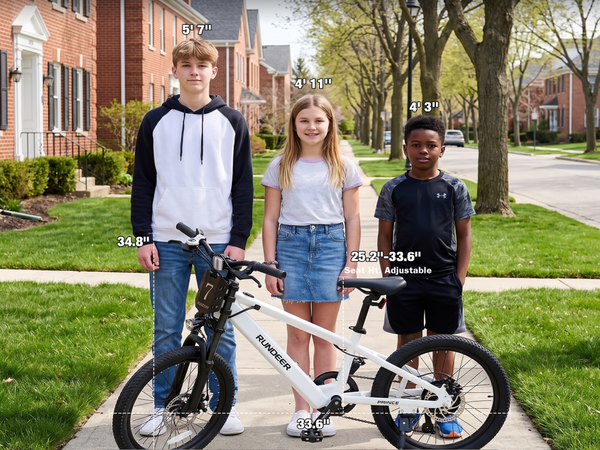
- Age and size appropriateness: Look for bikes designed for your child's age range and height (e.g., models accommodating ages 6–13 and heights 4'3"–5'7" / 130–170cm)
- Weight: A lighter bike is easier for kids to handle (look for models around 35 lbs / 16kg)
- Battery range: Ensure the battery can cover your child's typical routes (a 36V 10Ah battery delivering up to 32 miles / 50km of range is a strong benchmark)
- Motor power: A 250W motor with 500W peak output provides ample power for youth riders without being overwhelming
- Weight capacity: Check that the bike can safely support your child (up to 240 lbs / 108kg is a solid standard)
- Safety certifications: UL 2849 certification is increasingly required by incentive programs
Age-Appropriate Features
Safety features matter enormously when selecting a kids' e-bike. Look for models with adjustable speed settings, pedal-assist-only operation (no throttle), and a manageable total weight. These features not only keep young riders safe but also align with the requirements of many incentive programs that prioritize certified, class-appropriate e-bikes.
How to Find and Apply for E-Bike Incentive Programs
Step 1: Research Local Programs
Start by checking your city and state government websites for active ebike rebate programs. The TREC report's count of 118 programs across North America means there's a good chance something is available in your area. Utility companies and transit authorities also frequently offer incentives.
Step 2: Verify Eligibility Requirements
Each program has its own eligibility criteria. Common requirements include:
- Proof of residency in the program's jurisdiction
- Income verification (for equity-based programs)
- UL certification for the e-bike being purchased
- Age restrictions or requirements for the purchaser
- Purchase from an authorized retailer
Step 3: Confirm UL Certification Before Purchasing
Given the growing trend of requiring UL 2849 (and in some cases UL 2271) certification, it's essential to confirm that the e-bike you plan to purchase carries the necessary certifications before completing your transaction. Request documentation from the retailer or check the manufacturer's website.
Step 4: Apply Through the Program's Designated Channel
Some programs require pre-approval before purchase, while others—particularly point-of-sale programs—apply the discount automatically at checkout. Follow the program's specific application instructions carefully to ensure you receive the full benefit.
Step 5: Keep All Documentation
Maintain records of your purchase, including the receipt, UL certification documentation, and any program application materials. Some programs conduct follow-up verification, and having complete records will streamline the process.
Tips for Maximizing Your Savings
Beyond the primary incentive, families should look for opportunities to stack savings. Some utility companies offer separate rebates for e-bike chargers or energy-efficient transportation, which can be combined with state or city programs. Additionally, certain employers provide commuter benefits that may extend to e-bike purchases, so it's worth checking with your HR department. Tax-exempt states or periods—such as sales tax holidays for bicycles—can also reduce the effective cost of a kids' e-bike purchase.
Another often-overlooked strategy is timing. Many incentive programs operate on a fiscal-year calendar with limited annual funding. Applying early in the program year can improve your chances of securing a rebate before funds are exhausted. The TREC report notes that popular programs frequently run out of budget within weeks of opening applications, so staying informed about application windows is essential.
The Road Ahead: What to Expect in 2026 and Beyond
The U.S. e-bike market's projected growth from $4.06 billion in 2026 to $5.78 billion by 2031 (Mordor Intelligence) signals that e-bikes are becoming a mainstream transportation option—not just for adult commuters, but for families and children as well.
As the market expands, we can expect:
- More incentive programs at the state and local level, building on the 118 programs already documented by TREC
- Greater emphasis on point-of-sale discounts, reducing the financial burden on families
- Stricter safety requirements, with UL certification becoming a standard prerequisite for incentive eligibility
- Increased focus on equity, ensuring that low-income families have access to affordable, safe e-bike transportation
- Potential federal legislation, including a possible ebike tax credit that would apply nationwide
For families, the message is clear: now is an excellent time to explore e-bike incentive programs. Whether you're looking for a commuter bike for yourself or a kids' e-bike for your child, the combination of growing incentive availability, point-of-sale discounts, and safety-focused eligibility requirements makes 2026 a promising year to make the switch.
 Frequently Asked Questions
- What is an ebike incentive program?
- An ebike incentive program is a government, utility, or nonprofit initiative that provides financial assistance to reduce the cost of purchasing an e-bike. These programs can take the form of point-of-sale discounts, post-purchase rebates, or tax credits. According to the TREC report from Portland State University, there are currently 118 active programs across the U.S. and Canada.
- Do e-bike incentive programs cover kids' e-bikes?
- Yes, many incentive programs do cover kids' e-bikes, provided the model meets the program's eligibility requirements. These typically include UL safety certification (UL 2849 for the electrical system), compliance with local e-bike classification laws, and purchase from an authorized retailer. Parents should check specific program guidelines to confirm coverage for youth models.
- What is the difference between an ebike tax credit and an ebike rebate program?
- An ebike tax credit reduces the amount of tax you owe at the federal or state level, typically claimed when filing your annual tax return. An ebike rebate program, by contrast, provides a direct discount or refund—often applied at the point of sale. Rebate programs have become increasingly common, as the TREC report notes, because they provide immediate financial relief rather than requiring families to wait for tax season.
- Why do incentive programs require UL certification?
- UL certification—specifically UL 2849 for e-bike electrical systems and UL 2271 for batteries—ensures that the product has been independently tested for safety. As David McKnight of UL Standards & Engagement stated in the TREC report, requiring safety standards helps ensure that subsidized products have been "tested, certified, and designed with protection in mind." This protects both the consumer and the integrity of the incentive program.
- How can I find ebike incentive programs in my area?
- Start by checking your state and local government websites, utility provider pages, and transit authority announcements. The TREC report at Portland State University is also a valuable resource for identifying active programs. With 118 programs across North America, there's a strong likelihood that at least one is available in your region.
- Will there be a federal ebike tax credit in 2026?
- While discussions about a federal ebike tax credit are ongoing and the IRS has acknowledged e-bikes as a transportation alternative, no comprehensive federal credit has been enacted into law as of early 2026. The upfront cost barrier of $1,000–$4,000, as noted by Mordor Intelligence and IRS.gov, continues to drive advocacy for federal legislation. Families should monitor congressional developments while taking advantage of existing state and local programs.
Sources: TREC at Portland State University (February 2026 report); IRS.gov; Mordor Intelligence; UL Standards & Engagement; Consumer Product Safety Commission (CPSC).